
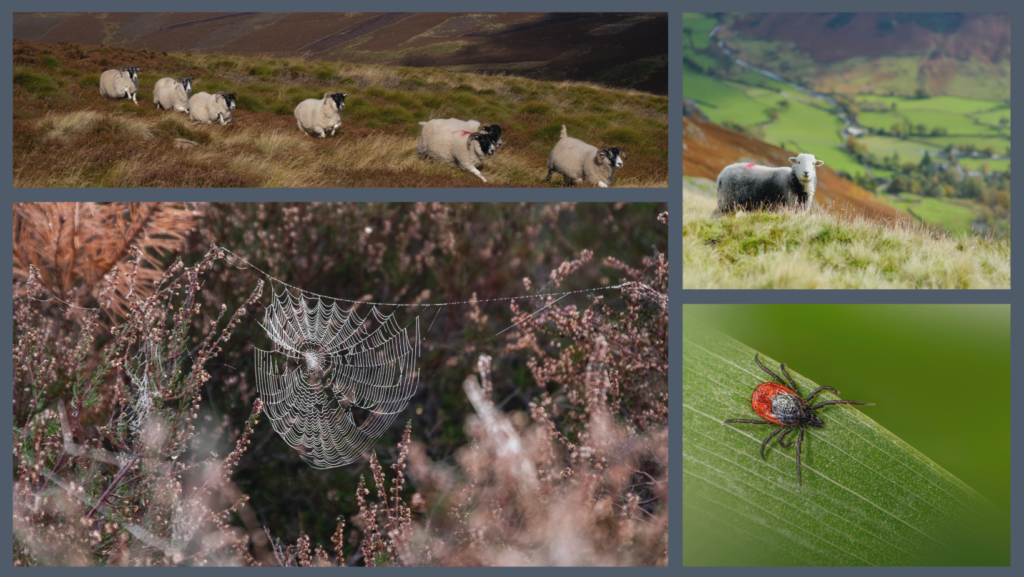




A Whole-System Approach to One of Farming's Most Persistent Challenges
And how learning to think differently about problems like this is exactly what we teach in Roots to Regeneration.
Every year, UK livestock farmers spend thousands on pyrethroid pour-ons.
Every year, the ticks come back.
I’ve been working with upland farmers across the UK for nearly three decades, and tick pressure is one of the most common frustrations I hear about. Farmers doing everything “right” — treating at the recommended times, using the recommended products — yet still facing the same battles season after season.
What if the treatments themselves are part of the problem?
New research is revealing something that conventional advice has largely ignored: the chemical interventions routinely used on UK livestock farms may be systematically undermining the biological systems that could regulate tick populations naturally.
This isn’t about blame. It’s about understanding why we’re stuck — and finding a way out.
The Dependency Trap
Here’s what the research now tells us:
Pyrethroid acaricides (Crovect, Butox, Bayticol, Dysect) are broad-spectrum neurotoxins. They kill ticks effectively. But they also kill:
- Spiders — which capture questing ticks in vegetation
- Ground beetles — which actively hunt tick larvae in pastures
- Ants — which raid tick egg masses
- Parasitic wasps — which attack engorged females
Each application buys temporary relief while degrading the predator network that provides ongoing, free, self-sustaining tick suppression.
Avermectin anthelmintics (ivermectin, moxidectin) used for worm control persist in dung for weeks. Research consistently shows they reduce dung beetle populations by 35% or more. Dung beetles aren’t just decomposers — they bury dung rapidly, disrupting the warm, moist microhabitats that ticks need to develop. They also attack tick eggs and larvae directly.
Fewer dung beetles means more favourable conditions for tick reproduction.
Evidence is also mounting that avermectins can induce gut dysbiosis — disrupting the microbiome that underpins immune function, including the inflammatory responses that determine whether ticks succeed in feeding.
The cumulative picture: pyrethroid tick treatments kill predators above ground; avermectin worm treatments affect the dung fauna and soil organisms below ground; and both may compromise the animal’s own immune defences.
The system is being degraded from multiple directions simultaneously.
I call this the dependency trap: intervention begets more intervention, while the underlying capacity for natural regulation is progressively degraded. The farmer becomes locked into an escalating cycle of chemical inputs with no end point, no long-term solution, and mounting concerns about resistance, residues, and environmental impact.
There Is Another Path
But here’s what’s hopeful: tick burdens are not primarily a pest problem requiring a pest solution. They’re a symptom of system dysfunction — the visible expression of imbalances that cascade through soil, plant, animal, and ecosystem.
When we understand ticks this way, we can see intervention points that chemical approaches completely ignore:
The soil environment where ticks spend 95% of their lives — vulnerable to entomopathogenic fungi and predatory nematodes that can achieve over 90% mortality in healthy soils
Plant nutrition — animals on diverse pastures with access to deep-rooted plants and browse naturally correct mineral deficiencies that affect immune function
The animal’s own defences — skin chemistry, grooming behaviour, gut microbiome health, genetic resistance
The whole ecosystem — predator networks, vegetation structure, habitat complexity
Each of these represents an opportunity for regulation. Each is compromised by conventional management. And each can be rebuilt.
How We Approach Problems Like This: The Red Flag Process
This whole-system perspective is exactly what we teach in Roots to Regeneration and in my farm consultancy work.
We’ve developed a structured process for analysing farm problems that moves beyond treating symptoms to understanding root causes. It’s based on recognising your farm as a series of nested systems — soil, plant, animal, ecosystem, climate — each influencing the others in ways that aren’t always obvious or linear.
When we assess a pest, disease, or performance problem in isolation, we miss these interconnections. We reach for the obvious solution — the chemical, the intervention, the quick fix — and wonder why the problem keeps returning.
The alternative isn’t a different quick fix. It’s learning to see differently.
I won’t lay out the full process here — it’s something we work through in depth during R2R, with support, over time. But I can show you what this thinking reveals when applied to ticks.
What This Thinking Reveals About Ticks
When you start looking at tick pressure through a whole-system lens, you see connections that single-problem thinking misses.
The soil connection: Healthy soils teem with organisms that attack ticks.
Entomopathogenic fungi like Metarhizium anisopliae can achieve over 90% mortality of ticks under field conditions — and they establish permanently, providing ongoing suppression. But these fungi need healthy, undisturbed soil biology to thrive.
The plant connection: Animals on diverse pastures with access to deep-rooted plants and browse can self-select for minerals and plant compounds that support immune function. Many upland plants contain secondary metabolites — tannins, terpenoids, and other compounds — with documented antiparasitic effects. But simplified swards of low-quality coarse grasses offer none of this.
The animal connection: Research shows that tick-resistant and tick-susceptible cattle have measurably different skin chemistry. Susceptible animals may literally smell more attractive to parasites. Nutrition, microbiome health, and genetics all play roles — and all are influenced by management.
The ecosystem connection: Ticks spend 95% of their lives off their hosts, vulnerable to predators. Ground beetles, spiders, ants, parasitic wasps, and birds all suppress tick populations. But simplified landscapes with routine pyrethroid use have depleted these predator networks.
The cumulative picture: When you add avermectin worm treatments to the mix — which reduce dung beetle populations by 35% or more, removing another natural check on tick habitat — you see how multiple routine interventions compound to create the very conditions in which ticks thrive.
This doesn’t mean there’s a simple alternative solution. There isn’t.
The Honest Truth About Working With Living Systems
Here’s what I won’t tell you: that this approach is easier, faster, or more predictable than chemical intervention.
It isn’t.
Living systems are complex. They don’t respond linearly. You can’t input X and reliably get Y. When you start rebuilding soil biology, diversifying pastures, and allowing predator networks to recover, you’re working with processes that have their own timing, their own thresholds, their own feedback loops.
Some changes happen faster than you’d expect. Others take years to show results.
Sometimes things get worse before they get better. Sometimes an intervention that worked brilliantly on one farm does nothing on another — because the context is different, the limiting factors are different, the system state is different.
This is genuinely difficult. It requires patience, observation, tolerance for uncertainty, and a willingness to keep learning. It requires accepting that you won’t always know what’s happening or why.
So why bother?
Because the chemical path doesn’t actually work either. It just creates the illusion of control while the underlying problems compound.
Resistance builds. Predator networks collapse. Costs escalate. And you’re no closer to a lasting solution than when you started.
The whole-system path is harder in the short term but it’s the only path that offers the possibility of genuine, lasting change — a farm that increasingly regulates itself rather than depending on escalating intervention.
That’s a different kind of farming. It requires a different kind of thinking.
This Is What We Mean by "Mindset Shift"
The same approach works for any persistent problem: liver fluke, pneumonia, fertility issues, weed pressure, soil degradation. Every “problem” is information about where your system is out of balance.
But you can’t just read about this and apply it. The shift from linear, single-cause thinking to systems thinking isn’t intellectual — it’s developmental. It changes how you see, not just what you know.
This is why our training at Roots to Regeneration is structured the way it is:
50% mindset transformation — learning to see your farm as a living system, with all the complexity and uncertainty that implies
40% systems design — creating a comprehensive plan for YOUR unique context, knowing it will need to adapt
10% specific practices — which become obvious once mindset and design are aligned
Most training programmes reverse this ratio. They focus 80% on practices — which cover crops to plant, which grazing system to copy. But practices without systems thinking get implemented through industrial logic. They treat farms like machines rather than living systems. And they produce disappointing results.
The farmers who successfully navigate regenerative transition are the ones who learn to think differently first — and who accept that working with living systems means working with complexity, uncertainty, and non-linear change.
Download the Full Report
I’ve compiled the complete research on whole-system tick regulation into a detailed report, including:
- The full evidence base for how chemical treatments undermine natural regulation
- Detailed mechanisms of soil, plant, animal and ecosystem-level tick suppression
- Practical recommendations for transitioning away from chemical dependency
- References to primary research sources
Want to Learn This Approach?
If this way of thinking resonates with you — if you’re tired of treating symptoms and ready to address root causes — I’d love to invite you to experience it firsthand.
Free Learning Session: January 14th, 4pm
Clare Hill and I are hosting a free 90-minute session where you can:
Experience our integral teaching methodology
See how we apply systems thinking to real farm challenges
Ask questions about your specific situation
Learn about the full Roots to Regeneration programme
“Designing YOUR Regenerative System: Why Copying Other Farmers Doesn’t Work”
This is the final session before applications close for our March 2026 cohort.
A Final Thought
The conventional approach to tick control has reached its limits. Resistance is increasing, environmental concerns are mounting, and decades of treatment have not produced lasting solutions.
The alternative is to rebuild the systems that nature designed for regulation: healthy soils, diverse plant communities, animals with intact immune function, and landscapes harbouring the organisms that naturally keep tick populations in check.
This approach requires patience, observation, and a willingness to work with uncertainty. It won’t give you predictable, linear results. It won’t be easier — at least not at first. And it demands a genuine shift in how you think about your farm and your role within it.
But unlike the chemical path, it offers what dependency never can: the possibility of genuine change — not just for ticks, but for the whole system your farm is part of.
The question isn’t whether you can follow a recipe. It’s whether you’re ready to learn a different way of seeing.
Caroline Grindrod is the founder of Roots of Nature and co-founder of Roots to Regeneration. She has nearly 30 years of experience in regenerative land management, working with organisations from family farms to large corporations and has trained farmers with influence over more than 500,000+ acres.
