
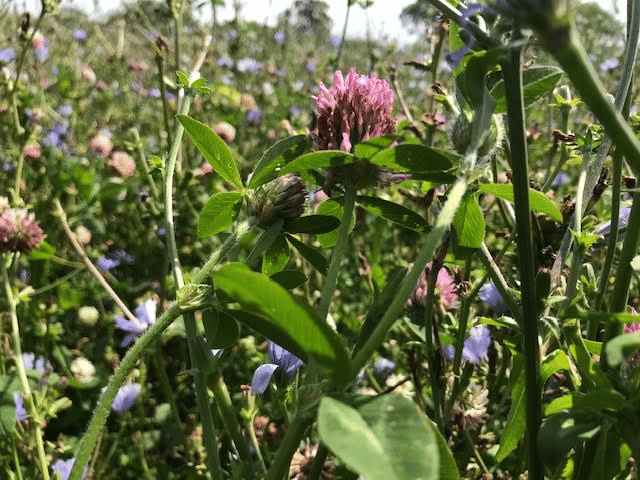
Look through any of the seed catalogues that have recently dropped on your desk and you will see herbal leys presented as the answer to everything. Drought resilience. Parasite control. Soil health. Biodiversity. A government subsidy to sweeten the deal. The seed companies have done extraordinary work. The industry has never been better at selling a four-year solution as a long-term strategy.
And farmers — sensible, pragmatic, experienced farmers — are ploughing up permanent pasture to put them in.
This is worth pausing over. Not because herbal leys are worthless. They’re not. Frank Newman Turner called them his “manure merchant, food manufacturer and vet all in one” — and he was right, in the arable rotations where he used them, in the 1950s, which is where the idea came from. The herbal ley is a break crop. A period of biological recovery between arable crops. A deliberate, temporary disturbance in a system that is already being regularly disturbed. That’s the context. Take it out of that context and you don’t have a tool — you have a habit.
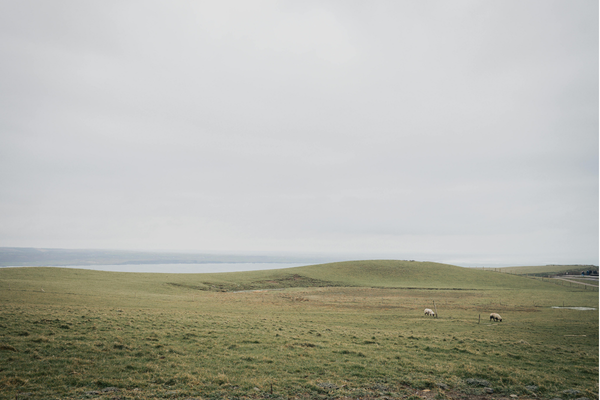
The habit now is this: farmers managing permanent grazing systems — no arable, no rotation, just stock on grass — are regularly cultivating land that in some cases has never been ploughed, to establish a commercial seed mix that will need reseeding in four to five years.
The herbal ley in these trials is managed rotationally. Proper rest periods. Adequate residuals. Entry at the right growth stage. The permanent pasture it’s being compared against? Set-stocked. Continuously grazed. Run at low residuals with whatever default management preceded the trial. That’s not science. That’s stacking the deck.
What would happen if you managed the permanent pasture regeneratively instead? This is the question that doesn’t get asked.
How We Got Here: The Herbal Ley Moment
To understand why herbal leys have swept through British livestock farming, you have to understand the genuine problems they were responding to.
Intensive post-war grassland management — monoculture perennial ryegrass, high nitrogen inputs, set-stocking — had produced a generation of impoverished, compacted, species-poor swards. Livestock performance was propped up by inputs. Soil organic matter was declining. Parasite burdens were rising. The countryside was becoming quieter every year as insect populations collapsed in fields that had nothing to offer them.
Against that backdrop, a diverse seed mix including deep-rooting herbs, nitrogen-fixing legumes and anthelmintic species like chicory and sainfoin looked genuinely transformative. It was. Herbal leys outperformed shallow-rooted ryegrass in drought years, held green when neighbouring fields parched, and showed genuine improvements in livestock health and soil structure. The argument was compelling and the industry ran with it.
The trial evidence is legitimate on its own terms. Most of the research compares herbal ley against ryegrass-clover leys — both freshly established, both managed rotationally. Within that frame, herbal leys perform well. The seed companies and advisers citing this evidence are not misrepresenting it. The trials show what they show, and within reseeded systems, the case stacks up.
The decision to plough permanent pasture is a different argument entirely — and it isn’t coming from the trials. It’s coming from the farmer standing in his own field.
What he sees is a field that has been set-stocked for decades. Cattle and sheep allowed to selectively graze the most palatable, productive plants first, year after year, until those plants can no longer reproduce. Their root systems shallow and dysfunctional. The high-quality grasses and forbs that once characterised the sward grazed out of existence — not through a single act of destruction but through the slow, cumulative pressure of animals choosing what they prefer. What remains is whatever the stock wouldn’t eat. Rank grasses. Unpalatable survivors. A plant community simplified down to its least valuable components over a timeframe measured in human lifetimes.
Against that, a freshly established herbal ley looks like an obvious win. In the short term, it probably is.
He is making a permanent decision about temporary underperformance.
And nobody — not the adviser, not the seed company — is asking the prior question: what would that pasture do if you managed it well first?
What if, instead of cultivating, you changed the grazing? Gave it proper rest periods. Moved the stock before the sward was hammered. Used bale grazing over winter to open the sward and feed the soil simultaneously. Let the seed bank respond — because it will, often surprisingly quickly, as plants suppressed for decades suddenly have the space and light to germinate and establish. What if you then overseeded once, carefully, with native wildflower material sourced from a local donor site — species adapted to that soil, that rainfall, that altitude — and grazed well to maintain the diversity that followed?
That question has never been answered at trial scale, because it requires patience most farm businesses aren’t currently structured to exercise, and nobody is funding a forty-year experiment. But it is not academic. It goes to the heart of what is actually being lost when a permanent pasture is ploughed.
In October 2024, Pasture for Life led a coalition of over thirty organisations — including the RSPB, Soil Association, Wildlife Trusts, Plantlife and the Nature Friendly Farming Network — in an open letter to Defra raising exactly these concerns. Good quality semi-natural grasslands were being ploughed or sprayed to enter the herbal ley scheme, they wrote. Their recommendation: prioritise supporting farmers to maximise the species diversity latent in the seed bank through grazing management — longer rest periods, adaptive grazing strategies, bale grazing, scarifying. Not cultivation.
The logic of the arable rotation — where soil disturbance is already priced in and the ley serves a defined break-crop function — has been applied wholesale to permanent grazing systems where the permanent pasture is the most ecologically valuable asset on the farm. Farmers are routinely ploughing land that has not been cultivated in generations, foreclosing a possibility that cannot be reopened on any meaningful timescale, in exchange for a four-year cycle that starts the clock again every time.
You bring dormant weed seeds to the surface where they can germinate. You create bare ground that is vulnerable to erosion, capping, and colonisation by opportunist species. And you eliminate the permanent sod — the dense, interlocking root mat that gives well-established permanent pasture its winter grazing integrity, its moisture retention and its resistance to poaching.
Then you do it again four to five years later, because that’s how long most herbal ley species persist before grass dominance reasserts and the ley degrades.
The cycle looks like this: establish at significant cost → field out of production → establishment failure risk → two to three years of good performance → progressive species loss as grass reasserts → reseed. Over a 20-year period, you have reseeded that field four times, each time resetting the soil biology, each time releasing carbon, each time creating a window of vulnerability, each time spending money you cannot fully recover.
A permanent pasture under regenerative grazing costs nothing to reseed because it reseeds itself.
There’s a deeper problem with the species in the bag. The legumes in a commercial herbal ley mix — red clover, white clover, sainfoin, birdsfoot trefoil — have been bred under domestication pressure for yield and establishment. The thing that’s been selected out of them, quietly and over generations, is the ability to reproduce. Pod dehiscence — the explosive shattering that distributes seed across the sward — has been systematically eliminated because it’s inconvenient for seed crops. The plants keep their pods closed. The seeds don’t leave. The next generation doesn’t happen without human intervention.
A botanist told me he’d noticed legume seed pods in herbal leys that simply wouldn’t open. He was right, and there’s solid science behind the observation. This isn’t a quirk. It’s the domestication deal. You get a plant that establishes fast and performs well. You pay for it by getting a plant that cannot persist without you.
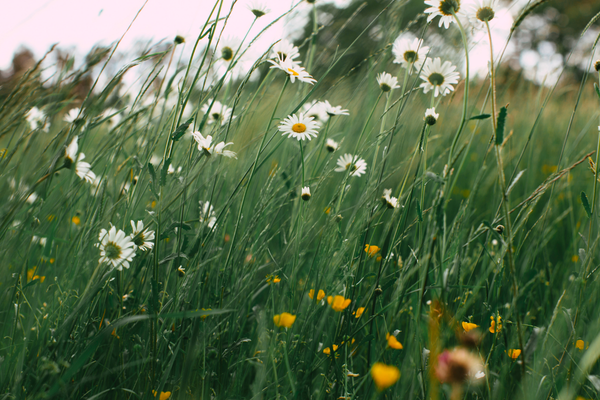
Native wildflowers — yellow rattle, ox-eye daisy, bird’s-foot trefoil selected from local donor sites, knapweed, devil’s bit scabious — don’t have this problem. They evolved to disperse. They evolved to wait in seed banks. They evolved to read the chemical signals in soil, the strigolactones produced by mycorrhizal fungi, that tell them the succession conditions are right to germinate. They don’t need reseeding. They self-perpetuate. Over time, under adaptive multi-paddock management that gives rest periods and allows seed-set, a sward seeded once with regionally provenant native wildflower material becomes progressively more species-rich. Not less. Not the same. More.
The real comparison — and the one this piece is making — is between a herbal ley reseeded every four to five years at significant cost and ecological disruption, against a regeneratively grazed, improving permanent pasture progressively seeded with regionally provenant native wildflowers, building species diversity, sod integrity, soil biology and resilience across a timescale of decades.
Over that timescale, the permanent pasture wins. The evidence is clear. The biology supports it. The economics, honestly accounted, justify the harder upfront investment. And the ecosystem value is incomparable.
None of this is straightforward. Regenerative grazing requires fencing infrastructure, water provision and the daily management discipline to move stock on time — a discipline that is harder than it sounds when the weather is bad and the field is far from the yard. Native wildflower seed of regional provenance is expensive and not always easy to source. Establishment is slower and more variable than a commercial seed mix, and the first two years will test the patience of anyone used to seeing rapid, uniform results. The economics require a longer planning horizon than most farm businesses currently operate on.
These are real challenges. They don’t change the underlying argument.
The permanent pasture — managed properly, seeded strategically once with the right regionally adapted material, given the management discipline to improve — is a better long-term investment than a four-year herbal ley cycle. The biology supports it. The economics support it. The ecology demands it.
And permanent pastures are not neglect. They are not the default you escape from by cultivating. They are the product of decades — sometimes centuries — of accumulated biological intelligence in the soil, in the seed bank, in the mycorrhizal networks, in the plant community composition. When you plough one up to put in a herbal ley, you are spending capital it took generations to build, for a return that will last four years.
That’s not regenerative. That’s just slow mining with a better-looking label.
Permanent pastures are not a default to escape from. They are the most ecologically sophisticated grassland systems in the temperate world. The goal is not to replace them with something that looks more interesting on a seed catalogue. The goal is to unlock what they are already capable of — through management, through strategic seed investment, and through the patient discipline of letting the land do what it knows how to do.
Written in dialogue with Claude (Anthropic). Ideas, arguments and experience are mine; AI helped research, structure and articulate them.