
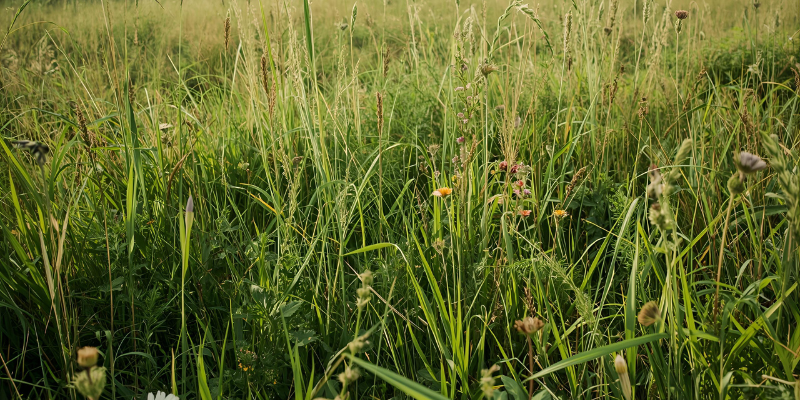
On the two grazing systems, the blaze of growth, and why the logic that works in one world doesn’t survive contact with the other.
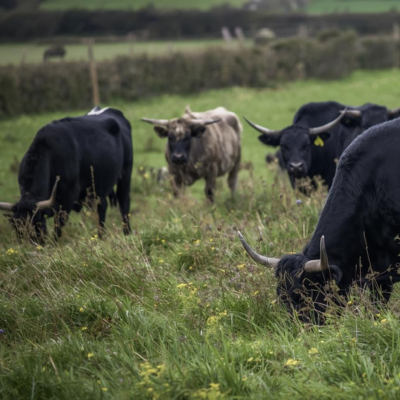
The pressure comes every year, around the same week. The grass greens up. The air temperature climbs. The feed and bedding costs are stacking and the cattle are looking far from their best. And then the neighbour’s stock go out, and that’s usually that.
I understand the logic. I’ve sat with enough suckler farmers to know it’s not sentiment or impatience that drives early turnout. It’s arithmetic. House a suckler cow and she costs you around £1.70 a day. Put her on grass and that drops to 70p. Fifty cows, a fortnight earlier, is several thousand pounds. And the entire infrastructure of the farm — the housing, the bedding system, the silage made to carry them through — has been built around the assumption that housing is the cost centre and grazed grass is where you claw it back. The faster you make that transition, the better. That’s not a failure of understanding. That’s a coherent response to a coherent question.
The question just isn’t the one every farm needs to ask.
Because there’s a different farm design sitting alongside that one, and it changes the calculation entirely. A regenerative farm running a summer grazing plan and a winter grazing plan — or outwintering its stock on cells of standing forage stacked through the summer — has already shifted its cost base. Housing costs are low or absent. The feed and bedding pressure that makes the April gate feel like an emergency doesn’t arise in the same way. That’s a design conversation. What matters here is that when you’ve removed housing as your main winter cost, the question you’re asking in April changes shape.
On those farms, feeding an extra bale in the winter paddocks before moving into the summer grazing platform isn’t a reluctant extension of a housing cost. It’s an investment with a measurable return — and if that forage isn’t purchased but grown and fed as standing forage through the summer, the cost drops to hardly anything. Siobhán Griffin — who has worked with farmers across multiple continents and more grazing systems than most people will see in a career — puts it plainly: every bale fed at this point to delay turnout can help grow ten in the main season. That’s not a peer-reviewed ratio. It’s practitioner wisdom. Because what you are buying with that bale isn’t just another day’s delay. You are buying the conditions for a fundamentally different kind of spring.
The question changes from: how do I reduce housing costs by getting out as early as possible? To: when is the land ready to enter the summer grazing plan?
And that second question has a precise answer. It was worked out by a French biochemist watching his cattle graze in Normandy in the 1950s, and it still holds.
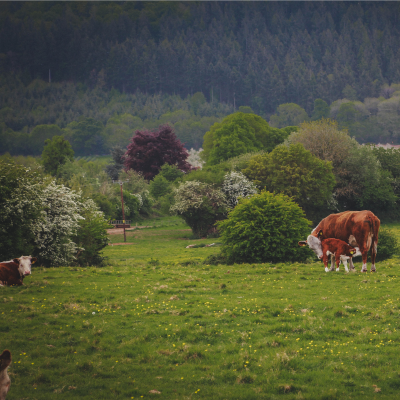
André Voisin called it the blaze of growth. He wasn’t being poetic. He was describing a specific moment on a measurable curve — the sigmoid growth curve that every grazed plant traces between one grazing event and the next. In the early days after defoliation, the plant has almost nothing to work with: root reserves mobilised to push out the first regrowth, minimal leaf area, few functional chlorophyll cells. Growth is slow, difficult, expensive in biological terms. Then, as leaf area builds, something changes. Each new green cell becomes both a product and a factory. More leaf means more photosynthesis, which produces more leaf. The growth rate accelerates. At the point where the canopy has intercepted roughly 95% of available light, the daily yield per acre is at its absolute maximum. That’s the blaze. Then, if you don’t graze it, the plant begins to redirect its energy toward reproduction — the daily growth rate slows, quality falls, leaf-to-stem ratio drops, and the nutritional value of what you’re harvesting starts to decline.
Allowing the leaf area to maximise before grazing — to reach or approach the blaze — is where production compounds. Graze before it and you’re harvesting the slow part of the curve, capturing the biological investment before it has generated a return. And there are good reasons to sometimes allow plants to go beyond it — deferring paddocks deliberately to build drought resilience, improve soil, or bank standing forage for the winter grazing plan. The blaze is not a rigid instruction. It’s a production principle. Understand it, plan your recoveries around it, and you have the tool to optimise output across the whole season — extending the growing season at both ends and building the reserves that make winter grazing possible.
Graze before the blaze and you’re harvesting the slow part of the curve — capturing the biological investment before it has generated a return.— Caroline Grindrod, Roots of Nature
Voisin was precise about the seasonal movement. Growth in August in northwest Europe is roughly half the rate of May, which means the recovery period required to reach the blaze is roughly twice as long. He calculated average optimal recovery times of around 18 days in May and 36 days in August for his farm in Normandy — and in much of the UK, particularly in the uplands, those periods will be longer still. The rotation lengthens as the season progresses — not because you’re falling behind, but because the biology demands it.
The arithmetic of getting this wrong is not proportional. Graze at half the optimal recovery period and you don’t lose half the yield. You lose two thirds. Voisin measured it: at half the optimum recovery time, production per acre drops to one third of what it would have been at the right moment. That’s not a marginal difference in management. That’s the difference between a farm that compounds its grass production across a season and one that degrades it in the same period — and the degradation is invisible in any single rotation, which is why it’s so persistently underestimated.
And then there’s what the recovery period does beyond the yield.
The recovery period isn’t just a yield management decision. It’s a sward composition decision made slowly, over years, in ways that most conventional grassland management doesn’t track. Adequate recovery — given consistently, season after season — selects for biological complexity. It favours species with deep roots, high grazing tolerance, and diverse phenology. Short, frequent grazing selects against them. Ryegrass is fast to recover and responds well to nitrogen; it thrives under pressure. Most of the species that make a sward genuinely resilient don’t. Under repeated early grazing, they quietly exit the sward. You don’t reseed them out. You manage them out, one rotation at a time.
Perennial ryegrass has around 75% of its root mass in the top ten centimetres of soil. When the dry spell arrives — and in the UK uplands, a dry fortnight in July is not an anomaly, it’s a predictable annual event — that’s the zone that dries out first. The ryegrass sward gets stressed and goes to seed. The farm that has been allowing long enough recovery periods to permit cocksfoot, plantain, birdsfoot trefoil and chicory to establish still has leaf area, still has depth, still has roots in the moisture. The 2018 drought demonstrated this across the country without ambiguity: diverse swards held on while monocultures failed — not because the diverse sward was ‘resilient’ in some abstract sense, but because its constituent species had physically different root architectures accessing water at physically different depths.
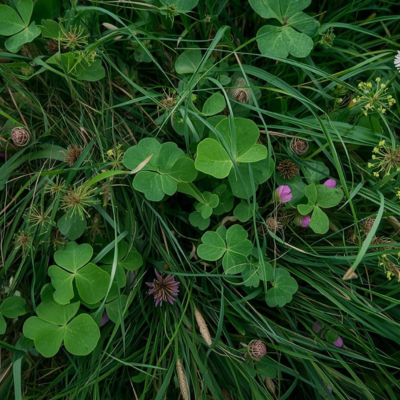
The tall, rested sward creates conditions invisible in conventional yield data. Dense canopy intercepts rainfall, reduces evaporative loss, and at night collects dew — condensation forming on leaf surfaces and dripping into the root zone. A sward maintained at adequate cover is not simply managing grass. It is maintaining a microclimate.
A sward grazed short — regardless of species — presents a hard, capped surface to summer rainfall. Water does not infiltrate effectively: it evaporates or runs off. A healthy tall sward captures every drop and delivers it to the root zone. In a dry spell, every grazing event that maintains residual height compounds the farm’s moisture advantage. Every event that removes it compounds the vulnerability.
The conventional system that applies maximum pressure to turn out early is built on the grass species most vulnerable to the summer dry that early grazing makes worse. Short rotations prevent the recovery periods that would allow diverse, drought-tolerant species to establish. In the absence of diversity, nitrogen applications maintain monoculture productivity — which justifies short rotations — which prevent diversity. When drought arrives, the farm has neither the root architecture nor the canopy structure to buffer it.
A regenerative farm designed around different questions does not face this trap in the same way. When the summer plan begins — entered at or near the blaze, with all paddocks having completed adequate recovery — a sward maintained with a good protective residual after each grazing is ready to grow again sooner than one grazed bare. Root systems are intact. Photosynthetic capacity is partially preserved. The sward recovers faster because it was never fully depleted.
Recovery periods must lengthen as the season progresses — the slowing growth rate demands it. But a sward grazed short must first rebuild its root system and re-establish leaf area before it can approach the blaze again. Its absolute recovery time is longer still. The farm that grazes short to extract more from each rotation is, in practice, extracting less — and waiting longer for the next opportunity.
The recovery period progressively lengthens through the season, sward complexity accumulates, roots deepen, and the architecture builds — retaining moisture, cycling minerals, sustaining photosynthesis through the conditions that a short-rotation, overgrazed system cannot survive.
You are not trying to do the same thing better. You are trying to do a different thing, in response to a different question, inside a different system.
Written in dialogue with Claude (Anthropic). Ideas, arguments and experience are mine; AI helped research, structure and articulate them. — Caroline Grindrod, Roots of Nature